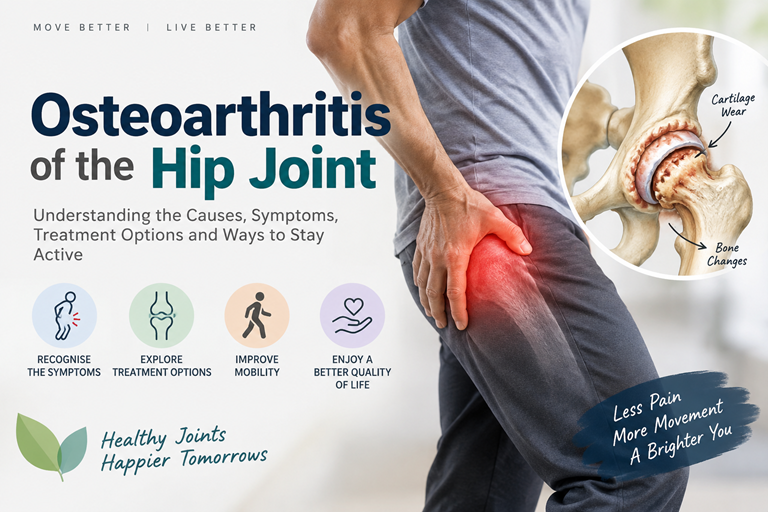
A hip joint is a ball and socket joint. It has a ball at the top of the thigh bone that fits into a socket in the pelvis.
The ends of bones in a typical joint are covered by cartilage (a smooth slippery surface). This smooth but tough cartilage surrounding the bones’ end help in the smooth movement of the bones against each other preventing friction. The cartilage within the joints acts like a shock absorber.
Joints naturally experience wear and tear throughout our lives due to normal aging, overuse, injury, or other factors. As a result, the cartilage in the hip joint can become thin, while the bone surfaces can become rough. Consequently, these changes may cause pain, swelling, and joint stiffness. This condition is known as osteoarthritis of the hip joint.
Although arthritis has many forms, osteoarthritis most commonly affects the hip and knee joints. In addition, doctors also call osteoarthritis degenerative arthritis or age-related arthritis. Generally, it affects older adults, and in particular, women may experience it more often than men.
What Happens If You Have Osteoarthritis of the Hip?
If you have this condition, you may feel pain in different areas, such as the thigh, buttocks, groin, or knee. In addition, you may experience sharp or stabbing pain or, sometimes, a dull ache. Furthermore, your hip may feel stiff, especially after periods of inactivity.
What Are the Symptoms of Osteoarthritis of the Hip Joint?
If you have osteoarthritis, you may experience the following symptoms:
- Pain, tenderness, or swelling in the hip joint
- Joint stiffness, especially after sitting for a long time
- Stiffness while getting out of bed, particularly in the morning
- Crunching sound in the joint
- Difficulty in moving the hip joint to perform routine activities
Arthritis Causes
- A family history (genes) inherited from parents
- Excess body weight (obesity or overweight)
- Heavy lifting
- Professions involving long periods of standing
- Deformity in the hip joint
- Injuries
- Age 45 years or above
- Overuse of the joints
- Repetitive stress and mechanical overload
- Hip fracture or hip trauma
- Hip dislocation
Diagnosis of Hip Osteoarthritis
Your doctor performs a physical examination, takes your medical history, and checks the mobility of your hip joint. Your doctor may order an X-ray. The X-ray of the hip joint shows spurring of joint margins and narrowing of the joints (thinning of cartilage in the joints) and joint space narrowing if you have osteoarthritis of the hip joint.
Management of osteoarthritis
Your orthopedic doctor, physiotherapist, occupational therapist, and dietician form a multidisciplinary team to effectively manage your condition. The management approach varies according to the stage and severity of the condition. Customized exercise programs, weight reduction methods, activity restrictions, balance training, and medications are included in a typical management program.
If these approaches do not offer any relief, as seen in most severe cases, total hip replacement surgery is recommended.
Learn more about Robotic Hip Replacement
Bottom Line
Osteoarthritis of the hip may progress to the point where you may need joint replacement. Early diagnosis and prompt management of the condition can help in preventing progressive degeneration of the cartilage and delaying surgery.
